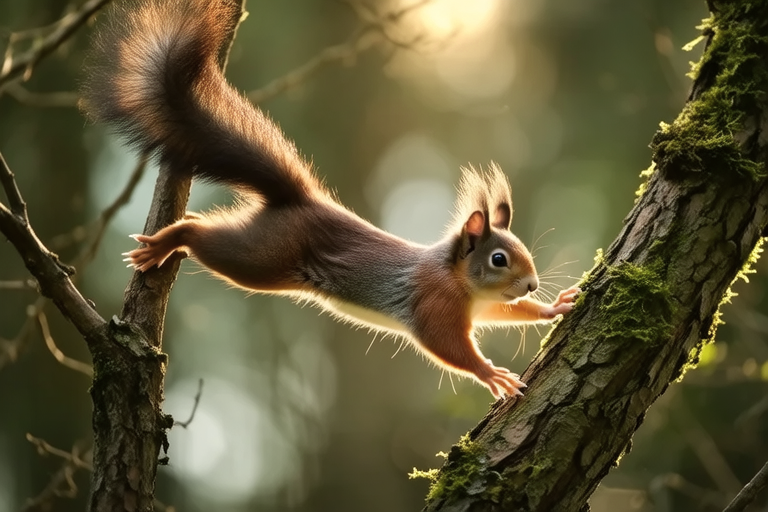
Squirrels: Acrobats of the Animal Kingdom
In the bustling world of wildlife, few creatures capture our attention quite like squirrels. These small, agile mammals have long been admired for their remarkable agility and dexterity. Their ability to leap between branches, navigate complex obstacles, and store food for the winter is nothing short of extraordinary. Squirrels are true acrobats of the animal kingdom, and their antics never fail to entertain and amaze those who take the time to observe them.
The Dance of Agility: Leaping Between Branches
One of the most captivating behaviors of squirrels is their incredible ability to leap from branch to branch with precision and grace. Whether they’re darting across a dense forest or skittering along power lines in urban settings, squirrels demonstrate an uncanny sense of balance and coordination. Their strong hind legs and bushy tails play crucial roles in their acrobatic maneuvers, allowing them to land gracefully on narrow perches or twist mid-air to avoid potential dangers.
Imagine watching a squirrel leap from one tree to another, its body arched in mid-air as it stretches out its limbs to catch the next branch. This fluid motion showcases the squirrel’s exceptional physical capabilities, making it seem almost like a professional gymnast. The way they can quickly assess distances and adjust their trajectory in real-time highlights their sharp instincts and reflexes.
Navigating Obstacles: A Masterful Display of Dexterity
Squirrels thrive in environments filled with challenges, and their dexterity allows them to overcome even the most daunting obstacles. In forests, they must frequently traverse gaps between trees, climb steep inclines, and squeeze through tight spaces. Their nimble paws, equipped with sharp claws, enable them to grip surfaces with remarkable strength, while their flexible bodies allow them to contort into awkward positions without losing their footing.
Urban environments present their own set of challenges, and squirrels have adapted remarkably well to life among humans. They can be seen scampering up buildings, crossing busy streets, and even riding on the backs of bicycles! Their ability to navigate these man-made landscapes with ease is a testament to their resourcefulness and adaptability. In both natural and urban settings, squirrels consistently prove themselves to be masters of obstacle navigation.
Storing Food: A Vital Skill for Survival
One of the most fascinating behaviors of squirrels is their methodical approach to food storage. During the fall, when nuts and seeds are abundant, squirrels engage in a process known as “scatter hoarding.” This involves burying individual caches of food throughout their territory, often under leaves or soil. By doing so, they ensure a steady supply of sustenance during the leaner winter months.
The act of burying food requires careful planning and execution. Squirrels will often dig multiple holes, each at varying depths and locations, to confuse potential thieves. They also exhibit a remarkable memory, capable of recalling the exact location of their hidden treasures even after months have passed. This skill is essential for their survival, as it ensures they can weather harsh winters and periods of scarcity.
Habitats and Challenges
Squirrels inhabit a wide range of environments, from dense forests to open grasslands and even urban areas. Each habitat presents its own set of challenges, and squirrels have evolved unique adaptations to thrive in their respective ecosystems.
In forests, squirrels face competition from other animals for resources such as food and shelter. To combat this, they have developed keen senses of smell and hearing, which help them detect predators and locate food sources. Their ability to move swiftly through the canopy allows them to evade ground-dwelling threats and access high-quality food sources that may be out of reach for other animals.
Urban squirrels, on the other hand, must contend with human activity and the ever-changing landscape of cities. They have adapted to scavenge for food in parks, gardens, and even garbage bins. Their ability to coexist with humans has allowed them to expand their territories and increase their population sizes. However, urban life also brings new challenges, such as exposure to pollutants and the risk of being struck by vehicles.
Diverse Species of Squirrels
There are over 200 species of squirrels worldwide, each with its own unique characteristics and adaptations. Some of the most notable include:
- Red Squirrel (Sciurus vulgaris): Found primarily in Europe and parts of Asia, the red squirrel is known for its striking reddish-brown fur and tufted ears. It is smaller than its North American cousin, the eastern gray squirrel, and tends to be more solitary in nature. Red squirrels are highly territorial and will defend their food caches aggressively.
- Eastern Gray Squirrel (Sciurus carolinensis): Native to North America, the eastern gray squirrel is perhaps the most recognizable species of squirrel. It has adapted well to urban environments and is commonly found in parks and residential areas. Eastern gray squirrels are excellent climbers and are known for their playful behavior.
- Ground Squirrel (Spermophilus spp.): Unlike tree squirrels, ground squirrels spend much of their time on the ground. They are found in grasslands, deserts, and prairies across North America and Eurasia. Ground squirrels are highly social and often live in large colonies, working together to protect their burrows from predators.
- Indian Giant Squirrel (Ratufa indica): As its name suggests, the Indian giant squirrel is one of the largest species of squirrel, measuring up to three feet in length. It is native to the forests of India and Sri Lanka and is known for its vibrant multicolored fur, which ranges from brown to orange to white. Indian giant squirrels are excellent climbers and spend most of their time in the upper canopy of trees.
Watching Squirrels in Action: Captivating Videos
For those who wish to witness the incredible acrobatics of squirrels firsthand, there is no better medium than video. Many websites and platforms offer a wealth of footage showcasing the natural abilities of these fascinating creatures. From slow-motion captures of their leaps and bounds to time-lapse videos of food caching, there is something for everyone.
One particularly exciting moment captured on video is a squirrel’s daring leap from one tree to another. Filmed from a bird’s-eye view, this footage provides a stunning perspective on the squirrel’s agility and precision. Another popular video shows a squirrel engaged in a game of hide-and-seek with a camera, demonstrating its intelligence and curiosity. Such clips offer a glimpse into the secret lives of squirrels and highlight the joy and wonder of observing nature.
By watching these captivating videos, viewers can gain a deeper appreciation for the beauty and complexity of the natural world. Squirrels serve as ambassadors for wildlife, reminding us of the intricate web of life that exists around us. Their playful antics and impressive skills make them a favorite subject for nature enthusiasts and casual observers alike.
Conclusion: Appreciating Nature Through Squirrels
Squirrels are truly remarkable creatures, and their agility, dexterity, and problem-solving skills make them acrobats of the animal kingdom. Whether they’re leaping between branches, navigating obstacles, or storing food for the future, squirrels consistently demonstrate their adaptability and resilience. Their diverse habitats and unique adaptations add to their charm, making them a fascinating subject of study for scientists and nature lovers alike.
Through videos and personal observation, we can witness the incredible feats of these small but mighty animals. By taking the time to appreciate the beauty and complexity of nature, we can deepen our connection to the world around us and foster a greater sense of wonder and awe. So the next time you see a squirrel, take a moment to watch its graceful movements and marvel at the magic of the natural world.
